Historical Markers in Cochran County
One collection, with each marker preserved in its own collapsible section.
Historical markers preserve stories that might otherwise disappear from the landscape. This page brings Cochran County's marker collection together in one place so the history can be browsed without moving between separate pages.
The historical summaries below are based on the marker inscriptions, Texas Historical Commission records, and local Cochran County historical information. Where a marker is missing, destroyed, or no longer associated with a surviving building, that status is noted.
If you know of another Cochran County historical marker, have a photograph of a marker or the place it commemorates, or have corrections or additional information, please email me.
Explore the Markers
Select a marker below to open that section.
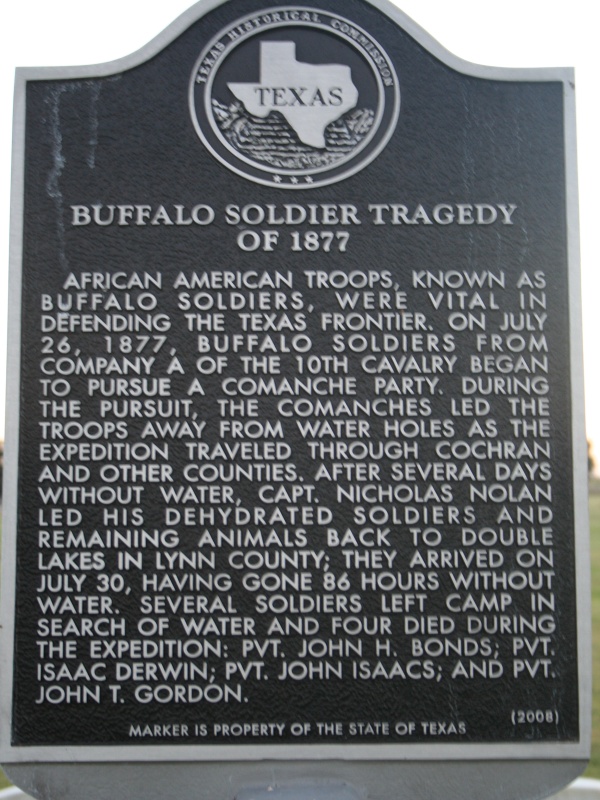
Marker No. 14745 • 2008 Buffalo Soldier Tragedy of 1877
Marker History
In July 1877, Company A of the U.S. Army's 10th Cavalry pursued a Comanche party across the western South Plains. The cavalrymen were Buffalo Soldiers — African American troops who served on the Texas frontier after the Civil War.
During the pursuit, the soldiers were drawn away from dependable water sources as the expedition crossed Cochran and neighboring counties. After several days of extreme dehydration, Capt. Nicholas Nolan led the surviving men and animals back toward Double Lakes in Lynn County. They reached water on July 30 after approximately 86 hours without it.
Four soldiers died during the expedition: Pvt. John H. Bonds, Pvt. Isaac Derwin, Pvt. John Isaacs, and Pvt. John T. Gordon. The marker at Morton Memorial Cemetery commemorates their service and the ordeal remembered as the Buffalo Soldier Tragedy of 1877.
Texas Centennial Marker • 1936 / 1965 Text Plate Cochran County
Marker History
The Cochran County marker commemorates the creation of the county on August 21, 1876, and its naming for Robert E. Cochran, who died defending the Alamo in 1836. The county remained extremely sparsely settled for decades and was not organized until May 6, 1924, when Morton became the county seat.
The marker records the tiny early population — only 25 residents in 1900, about 75 in 1910, and 67 in 1920 — before farming settlement accelerated during the 1920s. It also recognizes oil development and irrigation as major forces in the county's later growth.
The marker also notes Silver Lake, the saline lake in northeastern Cochran County known to early Spanish explorers as Laguna Quemado.
Recorded Texas Historic Landmark • 1969 First Telephone Office in Cochran County
Marker History
The building was erected in 1925 at Bledsoe, then the western terminus of the South Plains and Santa Fe Railway, for use by the Texas Telephone Company. It was moved from Bledsoe to Morton in 1926.
The telephone company eventually outgrew the small structure and stopped using it in 1949. In 1968 the building began a new chapter as the county museum, preserving one of the few surviving structures directly connected with Cochran County's earliest telephone service.
Recorded Texas Historic Landmark • 1969 Former Whiteface Motel
Marker History
Realtor William E. Flenniken built the Whiteface motel in 1926. It was the first brick building in the young town and provided lodging for prospective land buyers arriving while Cochran County ranch lands were being divided and sold in smaller tracts.
The J. S. Noel estate donated the property to Girlstown, U.S.A. in 1968 for use by the institution's management. The building received Recorded Texas Historic Landmark recognition the following year.
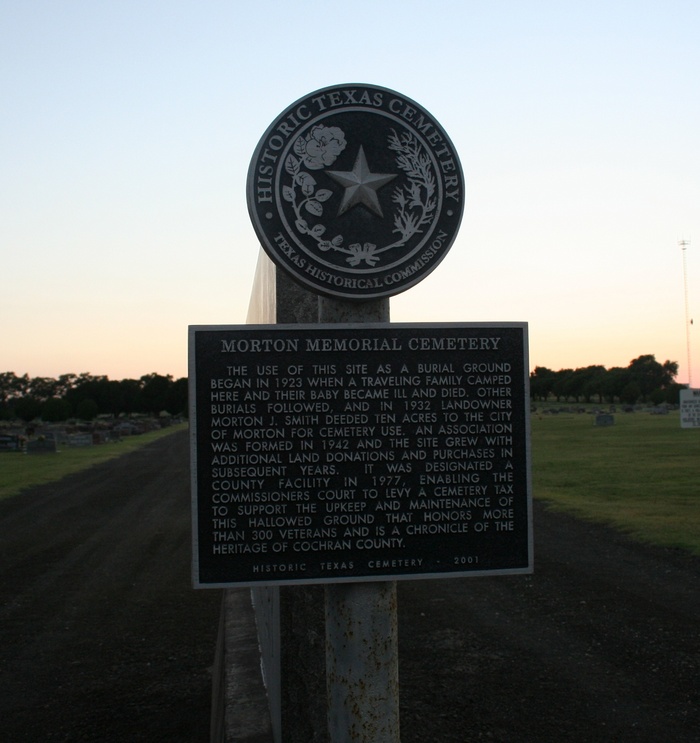
Marker No. 16171 • 2001 Morton Memorial Cemetery
Marker History
The cemetery began in 1923 after a traveling family camped at the site and their infant became ill and died. Other burials followed as Morton and the surrounding farming country began to develop.
In 1932 landowner Morton J. Smith deeded ten acres to the City of Morton for cemetery use. A cemetery association was organized in 1942, and later land donations and purchases enlarged the grounds.
Morton Memorial Cemetery became a county facility in 1977. The cemetery preserves the graves of generations of Cochran County residents, including more than 300 veterans, and serves as an important record of the county's families and communities.
Marker No. 11812 • 1999 Old Surratt Territory
Marker History
The Old Surratt Territory once encompassed more than 33,000 acres and represents the large-ranch era that preceded widespread farming settlement in Cochran County. Marshall Surratt, an East Texas native who became a Waco attorney and district judge, purchased 53 sections of land in 1885.
Surratt himself never lived in Cochran County. He leased the property to the Jumbo Cattle Company, operated by Nick and John Beal and their brother-in-law F. G. Oxsheer. Wells and windmills supplied water for cattle across the otherwise dry grasslands.
The territory passed through a succession of absentee owners after 1900 but remained largely intact until 1953. Its history illustrates the transition from vast ranch holdings to smaller farms and ranches as Cochran County's population increased during the early twentieth century.
Recorded Texas Historic Landmark • 1962 Slaughter Ranch Headquarters
Marker History
C. C. Slaughter assembled a ranch of approximately 246,669 acres in Cochran and Hockley counties between 1898 and 1901. The first headquarters serving the operation was a half-dugout, reflecting the sparse conditions of the county's early ranching period.
In 1915 the C. C. Slaughter Cattle Company brought workers from Mexico to construct a much more substantial headquarters. The adobe-and-concrete complex was arranged around a quadrangle in the manner of a Spanish hacienda and was regarded as one of the finest ranch headquarters buildings of its era in Texas.
Recorded Texas Historic Landmark • 1962 Smith Office
Local History
Morton J. Smith played a central role in the creation of Morton and in the settlement of the surrounding former Slaughter lands. After the Morton townsite was staked in 1923, Smith operated a small land office on the east side of the square while promoting and selling land to incoming settlers.
The office remained a recognizable part of early Morton for decades. Although the building and its Recorded Texas Historic Landmark marker no longer survive, the Smith Office remains important to the story of how Morton developed from a promoted townsite into the county seat of an organized county.
Marker No. 5522 • 1970 Town of Bledsoe
Marker History
Bledsoe was promoted and founded in July 1925 by the South Plains and Santa Fe Railway and was named for railroad president Samuel T. Bledsoe. Because it stood at the western end of the railroad line, it quickly became an important cattle-shipping point.
During the late 1920s Bledsoe briefly became the largest town in Cochran County. The marker records a population peak of 750 before reduced rail freight traffic and other changes began a long decline during the 1930s.
If you have information about the location of the missing marker or an older photograph showing it in place, please contact me.
Local Historical Marker • Dedicated 2015 Winder Building
The Winder Building and Early County Government
Morton J. Smith built a general store on the southwest corner of the Morton square in 1923 and sold it to Jerry Lee Winder in January 1924. The Winder family was among Morton's earliest families, arriving while the settlement was still extremely small.
Winder's General Store also became Morton's first post office. The post office was officially commissioned in March 1924, with Mary Winder serving as postmaster.
The building has an especially important place in Cochran County government history. On May 7, 1924 — the day after county organization — the first Cochran County Commissioners Court met at Winder's General Store. The store served as the temporary courthouse while the newly organized county established its offices and began conducting official business.
A historical marker was dedicated at the County Annex/Winder Building during the Texas' Last Frontier Heritage Celebration in 2015, preserving the building's connection to Morton's earliest commercial life, postal service, and county government.
Texas Historical Commission
The Texas Historic Sites Atlas provides official marker records, locations, designation information, and additional data for historical markers throughout Texas.
Help Preserve Cochran County History
Historical markers are only one part of the county's historical record. Photographs of markers, older photographs of the sites they commemorate, newspaper clippings, documents, family histories, and personal recollections can help preserve the stories behind them.
If you have photographs, information, corrections, or additional history concerning one of these markers, please email Mary Helen McKnight.